Friday, 30 December 2016

Dealing with Uncertainty

Throughout the blog, I've been talking about how we have utilised both climatic and hydrological computer models to make predictions for how the hydrological cycle may change in the future, and the effect it will have on humans. This week, I'd like to focus on the overall methodology and philosophy behind this method, and address the topic of uncertainty. While the scientific community is generally in agreement in what the impacts of climate change on the hydrological cycle may be, note that in previous posts I've mostly used the words 'could' or 'may' when talking about potential changes. Nothing is set in stone, and the process of trying to predict the future is inherently something of a dark art. 

In theory, the study of the effects of climate change on the hydrological cycle is undertaken to allow us as humans to understand why changes may be occurring, and how we can adapt to those changes. However, one of the key challenges in factoring climate change into management of water resources is uncertainty. In England and Wales, a small set of only three climate scenarios (derived from a variety of climate models) has been used to suggest a potential range of impacts, mostly focusing on one central scenario, and using very simple mathematical approaches to apply the scenarios (Arnell, 2011). In contrast, some approaches have used very large numbers of scenarios to assess impact (e.g. Christierson, et al. 2012), and assess the probability of certain impacts occurring, a feature that is very useful in risk assessment. However, it has been suggested that assessing the probability of hydrological changes in this way is impossible due to the considerable scientific uncertainty on how the climate system and hydrological system may change, and how to represent these possible changes. Stainforth, et al. (2007) argue that it is not possible to develop purely quantitative probability distributions of the impacts of climate change on water resources, and that the philosophy of representing uncertainty needs to change, potentially by interpreting the outcome of modelling studies less quantitatively - e.g. looking for a overall patterns and general magnitudes of change, rather than absolute values. 

This really is something of a debate in the scientific community; some feel we can use models to identify the risks of hydrological change and inform adaptation, while some feel they are simply not reliable enough to do this. Koutoyiannis, et al. (2008) compare the hydrological outputs of a variety of climate models to observations around the globe, and argue that global climate models perform very poorly at a both a small and large spatial scale. Wilby (2010) develops this argument further, suggesting a conceptual divide in the hydrological science community between those who advocate a scenario-led approach to water resource adaptation, and those who feel scenarios are better used to assess potential adaptation options. Wilby notes that hydrological processes are incredibly diverse in  in time, and as a result the management questions that need to be answered vary dramatically in time too, spanning minutes for real time flood protection through to multiple decades for provision of water. It is suggested that climate models are not reliable enough to answer the questions required for future adaptation as a result of their inability to accurately reproduce the temporal characteristics found in hydrological records.

The other side of the debate are those who think models are robust enough to inform hydrological adaptation, and feel that the critique of climate models is unjust. In a particularly strongly worded journal article, Huard (2011) attacks the publication of papers suggesting climate models cannot inform water management, claiming they are based on the misconception that climate models predict natural climate variability in a deterministic way, involving no randomness and always producing the same result given a certain input. Huard notes that this is indeed how hydrological models operate, but that this is not the way global climate models work. They are inherently chaotic and non-deterministic in their nature, with both the natural variability of the climate system and the influence of external factors playing a role. As such, a climate projection is not a deterministic prediction of climate, but 'an experiment probing the model's response to changes in greenhouse gas concentrations'. Assuming this, it is unreasonable to suggest that individual climate models should be able to predict past hydrological observations with supreme accuracy, given that they have to randomly simulate natural climate variability. To properly assess a climate model's performance, it is necessary to extract the response to external anthropogenic forcing from the inherent random natural variability.

Uncertainty in climate modelling is a huge topic, and I've only presented a short introduction to it here, but I think it is an extremely important topic to discuss, seeing as we are making a lot of predictions and decisions based on climate models. While it is a boring and non-controversial opinion, I sit somewhat on the fence on this issue. I certainly feel that climate models are of great value, but that they are experimental sandboxes that should be used to inform adaptation, as opposed to being what we base adaptation on. Quite frankly we do not have enough time to debate how we should interpret uncertainty, and need to actually get on with finding a framework of how to use all the data and projections available to inform adaptation!

Saturday, 24 December 2016

Christmas Warmth

It's Christmas Eve, and Santa will be loading up his sleigh. However, he might have quite a sweat on while he does this - news headlines today have included the story that temperatures at the North Pole may be 20°C above average today, which would break all records. I realise this isn't strictly related to hydrological change, but this is so interesting I think it is worth taking a quick festive look at. These sorts of temperature changes will no doubt have an influence on the hydrological cycle; as we know, warm air can hold more water.

Two weeks back, I touched on how 2016 has been a record breaking year for temperatures globally, but this heatwave event in the Arctic really is something else, likely a 1 in 1000 year event. The temperature at the North Pole today is about 0°C, which for Santa is very warm - he prefers the -20°C average. Scientists are confident these anomalous temperatures are a result of the influence of anthropogenic climate change. It's quite pleasing to see this story make the headlines today, as I think it is something the general public were not particularly aware of. Global public awareness of anomalous climate events and their link to anthropogenic warming can only be a positive thing - though I think the story only made the news due to it's link to Santa and Christmas! I don't think a temperature anomaly of 20°C in the Amazon would have been reported today....

I will leave the final words to Dr Thorsten Markus, chief of NASA's Cryospheric Sciences Laboratory, who has discussed what is really the true issue of the day - Santa's sledding attire.:

"Santa is most likely overdressed. Maybe in the future we'll see him in a light jacket or plastic mac."

The Boxing Day sales could prove useful if this is the case. Happy Hydrological Christmas!

Wednesday, 14 December 2016

A Mental Struggle

Over the past weeks, I've touched on some of the key issues that changes to the hydrological cycle as a result of climate change may cause for human physical health - a lack of  water causing illness and famine, the spread of water-borne diseases through drinking contaminated water, and the threat to health from extreme flood and drought events. However, human health extends beyond physical health issues to mental health issues. It isn't something that is talked about very much, but climate change and its resultant effects on the hydrological cycle pose a risk to mental health, a key aspect of human well-being. Dealing with problems of this scale and complexity is not easy, and this can take its toll on the human brain.

Changes in the hydrological cycle can cause changes to the environments with which people feel familiar, whether through flooding, drought, storm surges, or pollution of water resources. Humans complex brains are able to develop strong bonds between other people and the physical environmental that surrounds them - the 'sociophysical' environment. The disruption that hydrological climate change can cause to the environment so cherished by humans can cause grief, a sense of loss, and great anxiety. This has been coined 'solastalgia' - the distress caused by environmental change (Albrecht, et al. 2007). 

There are many case studies that provide examples of solastalgia. For example, Brubaker, et al. (2011) demonstrate the stress and fear that has been experienced in Alaskan villages that have become increasingly vulnerable to flooding and storm surges during the storm season, with residents reporting sleepless nights and stress during spells of bad weather. Interestingly, residents reported feeling 'safer' and 'happier' after the construction of a 1,000m long sea wall; hard engineering is often perceived by the public to be what will keep them safe from disaster. 

The Lancet Commission report on global health and climate change provides another example, suggesting that  the recent decade-long drought in Australia has caused an increase in depression, anxiety and possibly suicide rates in rural populations. Drought means the livelihoods and key sources of financial income of these rural populations are affected (crop and animal farming), causing great distress. This distress is compounded by feelings of powerlessness in the face of climate change; try putting yourself in their shoes and you can see why the drought has taken such a toll on these populations.

As climate change progresses, some local communities will have to face the task of planning and adapting to environmental change. Mentally, this is not an easy process. Coastal communities that may be suffering from erosion as a result of storm surges and rising sea levels provide an example of how mentally difficult the decision making process might be. In some coastal communities, the only solution is a managed retreat, which can cause great distress associated with place attachment - it is hard to accept that a cherished place to which you are attached may be allowed to erode away, with no attempt at defending it (Ageyman, et al. 2009). Imagine you were told that your seaside cottage will not be defended and left to fall into the sea; this has happened in the UK, and some have taken matters in their own hands and have attempted to engineer their own coastal defences, whether legally or illegally. You can see why.

An example of do it yourself coastal engineering in Suffolk - the darker band of soil is a man-made addition by the homeowner, who was taken to court. Credit:

Understanding these links between hydrological climate change and mental health is not easy - climate change works in the language of  numbers, and mental health works in the language of emotions. Quantitative (numeric) study of the link has been proposed through an 'Environmental Distress Scale'  (Higginbotham, et al. 2007), which 'combines dimensions of hazard perception, threat appraisal, felt impact of changes, ‘solastalgia’’ (loss of solace), and environmental action'. While this index may potentially be useful in some cases, it is hard to model some climate-mental health relations due to their inherently non quantitative nature, so we may need to develop some innovative qualitative (descriptive, non-numeric) ways of understanding the impacts of climate change on mental health. Climate change is not just about numbers and graphs when we are talking about the effects on humans. 

While I've talked about some serious issues in this post, don't have nightmares, and keep everything about hydrological climate change in perspective! We as humans have caused these changes, and it is within our grasp to mitigate, adapt, and reverse them. However, do remember that climate change is already happening, and for some is causing great mental distress. It really is important to talk about this - just as important as the physical effects of climate change on humans.

Wednesday, 7 December 2016

COP21 - One Year On

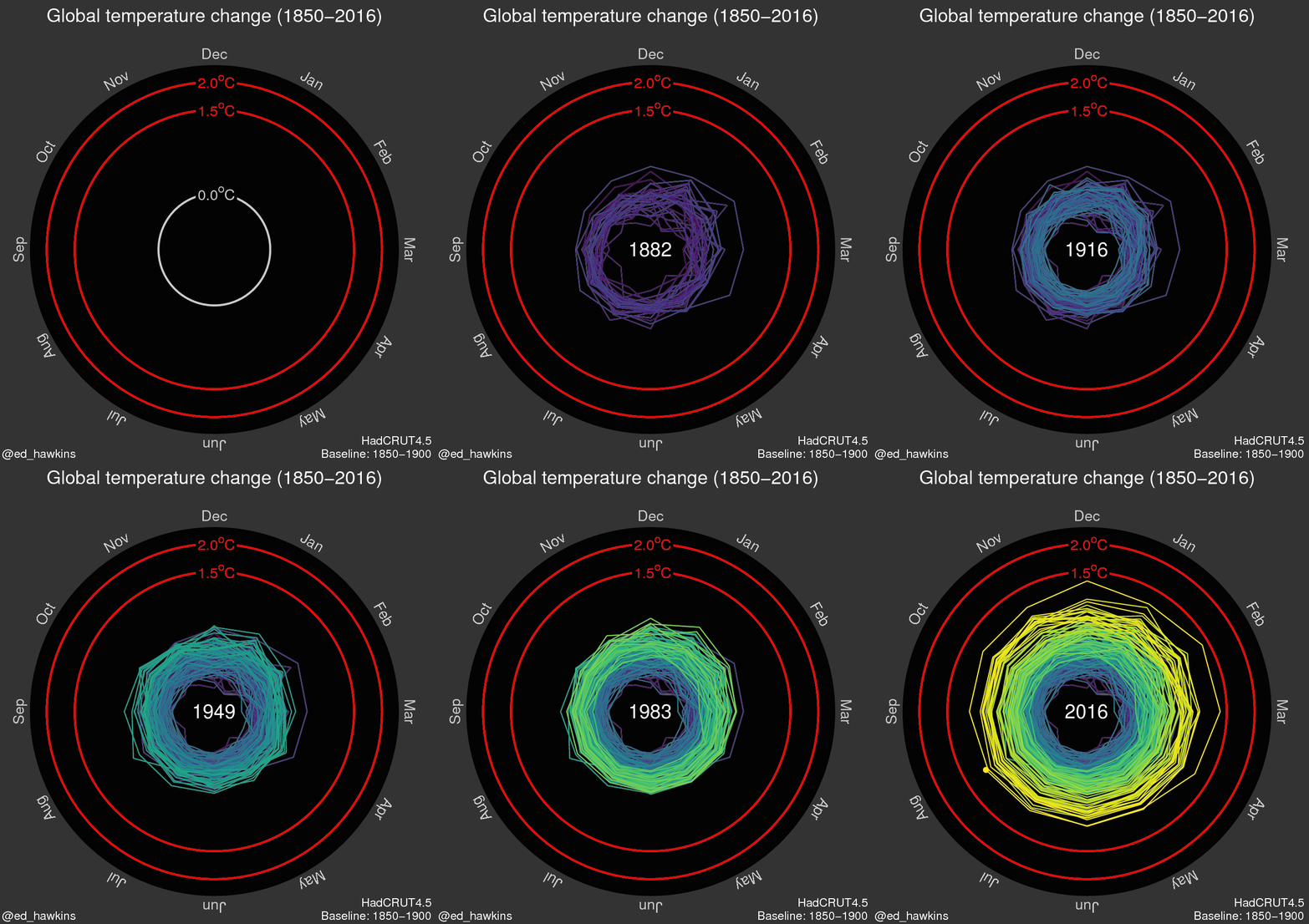
We are currently one year on from the historic COP21 Negotiations in Paris, where some agreement was made between politicians of all nations to attempt to reduce emissions. This is obviously very important with respect to the potential changes to hydrological cycle I have already talked about. The target is to keep the warming of the earth's climate below 2C, but I personally believe that is now impossible. Why? This is a very popular animation of global temperatures that recently became viral, but it indicates an important point - we are coming close to pushing 1.5C of warming already, with 2016 being a year that has broken records temperature wise. Just look at the end of the animation; it will comfortably become the warmest year on record. Admittedly, it is a year with a strong El Nino (a climate phenomenon that leads to warmer temperatures globally), but even accounting for this, it is incredibly warm.

Credit: Ed Hawkins


To celebrate anniversary of COP21 , I thought I'd share a cartoon that amused me. This is a bit of fun and not at all realistic, but behind the cartoon there is an important message - will we ever really do anything major to act internationally as things stand?  Only time will tell if the agreements reached at COP21 will have any impact, particularly given events such as a the recent election of Donald Trump in the USA. I still worry for the changes to the hydrological cycle that are yet to come, but also remain optimistic that humans do have to power to enact change. We just have to give ourselves the chance to enact change - we are so dependent on water. Enjoy the cartoon.

Credit: The Economist

Wednesday, 30 November 2016

There's a Storm a Coming

The UK has just experienced its first named storm of Autumn 2016, Storm Angus, which hit the UK on the 20th November. As a result, there were some quite nasty weather conditions and impacts for the south of the UK - flooding, power cuts, ships running aground, and car accidents causing people to be hurt, though there were thankfully no fatalities. Take a look at this nice summary by the Met Office if you are interested in what happened. It is too early to say how much damage was caused by the storm, but this picture of a street in Bristol indicates the sort of issues that might have occurred:

Credit: Lee Gitsham/PA
In light of this recent storm, and following on from the article about jet stream research I posted a few weeks back, I thought it topical this week to explore the relationship between intense weather events and climate change, with a particular focus on the UK. At a global scale, there is consensus from the IPCC that climate change will lead to more extreme rainfall events in the future, but with a higher number of dry days. This is caused by the fact that in a warming world, air can hold more water vapour before it reaches the point where it must fall as precipitation. As such, there will be less rainfall events as a whole (it takes longer for the amount of water needed for there to be rain to build up), but the rainfall events that do occur will be more extreme in both their intensity and duration. There are obvious implications from this sort of climatic arrangement - an increased risk of flooding, damage, and loss of life during extreme weather events.

The discussion has already begun as to whether the recent Storm Angus has been influenced by climate change. The UK has experienced a succession of strong and destructive winter/autumn storms in the past 5 years, leading to widespread debate as to whether climate change is affecting weather patterns in the UK. During the recent severe floods of 2013/14 in southern England, Prime Minister at the time David Cameron told parliament that he 'very much suspected' anthropogenic climate change was associated with the event.  These floods were quite severe, and caused by continual low pressure storm systems moving in from the Atlantic across southern England, with a consistent amount of high level precipitation leading to flooding.

It is very hard to pin a single extreme weather event to climate change; it is simply one event in a chaotic system, and it is hard to tell whether that one event is due to a change in the boundary conditions of the system, or is simply a natural part of the chaotic system. Despite that, attempts have begun to examine whether anthropogenic climate change may have increased the risk of the occurrence of heavy storms and resultant flooding that have been recently been experienced in the UK.

The first piece of such research was published earlier this year by Schaller, et al. (2016), who examined the potential influence anthropogenic climate change had on the floods of 2013/14 in southern England. They conclude (through the use of a variety of climate model simulations) that along with the atmosphere being able to hold more moisture, anthropogenic warming has likely caused a small increase in the number of January days that have a westerly airflow, and a stronger jet stream. In combination, both of these factors increase the risk of the UK experiencing events of extreme precipitation.

The study then feeds this information into a hydrological model, in an attempt to understand how this event affected the River Thames - the area around the Thames is one of the key places flood damage to property occurred during 2013/4. It is found that under these the conditions experienced in 2013/4, the 30 day average of peak river flow in the Thames increased significantly. Combining these results with flood risk mapping, a small increase is found at the number of properties at risk from riverine flooding, though there is great uncertainty in the true value of the number. Despite this, similar events of a greater intensity could lead to even greater flood damage.

All of the aspects of this study have large bounds of uncertainty - the conclusions that have been drawn are simply the best estimates of the data available, reflecting how anthropogenic climate change has so far only had a subtle impact in increasing the risk of intense precipitation events in the UK. Far more attribution studies of this type are needed to begin to understand how climate change is affecting UK weather patterns. However, it is reasonable to suggest from this study alone that it is likely anthropogenic climate change may be beginning to influence extreme weather events in the UK - keep an eye on the weather forecast this winter! The next named storm we experience in the UK will begin with a B, so guesses for the name in the comments please! I'm going for Storm Bertha.

Tuesday, 15 November 2016

A Glass of Water - Part 2


In my last post, I explored how increases in temperature and rainfall as a result of climate change may affect the drinking water that we rely on as humans. There are some more factors to consider though, which I will cover in this post. Before we start though, why not go to the kitchen and pour yourself a glass of water from the tap? Drink it while you read this post. While you do that, I will run through some more potential effects of climate change on drinking water.

Drought

While it is never a good thing for water to contain pollutants, it’s best to have a small amount of pollutant in a large amount of water. This means the pollutant is more diluted in the water, with less pollutant per unit of water. Think of it in terms of a glass of orange squash – the ratio of the squash to water influences how strong the taste is, and it is the same with water pollution. You are more likely to get sick from drinking water concentrated with pollutants, rather than water in which the pollutant is more diluted.

Droughts reduce the amount of water in a hydrological system, due to a lack of rainfall and increased evaporation, but the amount of any pollutants in water remains the same. As such, droughts reduce dilution of pollution, increasing pollutant concentrations in water. The IPCC suggests it is likely that the frequency of droughts will increase in presently dry regions by the end of the 21st century, and this could have significant implications for drinking water. There are still high levels of uncertainty in the quantification and projection of drought at a regional scale using climate models, but we know that droughts have increased in the Mediterranean, Central America and South Africa, and it is projected that they will increase into the future (Orlowsky and Seneviratne, 2013). 

The effect of drought in reducing the dilution is well documented. van Vilet and Zwolsman (2008) use existing water quality data to show a decline in the water quality of the Meuse river in north-west Europe during drought conditions, with increases in heavy metals, major elements, and the amount of algae in the river (the river flowing more slowly allows algae to develop, along with an increased nutrient concentration). As we saw in the previous post, algae have a negative effect on water quality. Bonte and Zwolsman (2010) show a similar effect for two man made lakes in the Netherlands, but in this instance using modelling to attempt to predict to effect of climate change induced changes in water quality. Using climate change predictions for 2050, the model suggests an intense salinisation (the water becoming more salty) of the two lakes due to increased chloride concentration as a result of low river flows, evaporation, and reduced rainfall. 

All of these effects are not good for human drinking water - hopefully that glass of water you are drinking isn't rich in heavy metals, algae and salt. They are not good things to put into your body. 

Sea level rise

Sea level rise is perhaps the most discussed topic in all of climate change, and as we all know is a major consequence of climate change and global warming. It could have significant impacts on drinking water quality as a result of a process called saline intrusion, which involves salty sea water workings its way into a freshwater aquifer, causing groundwater to be contaminated with salt. Take a look at this before and after diagram:


On the left is the normal state of things - the freshwater (light blue) separated from the salty water (dark blue). Remember that these are not bodies of water, but just the water that is stored in rock, deep beneath the sea bed. The well will be pumping up only fresh groundwater.  On right, is a situation likely to occur as a result of sea level rise - the sea level has risen, and as a result there has been an intrusion of salt water (towards the left, in this case). As a result, the same well will now be pumping up somewhat salty water. If we assume this well is used to supply a coastal village with drinking water, you can see the problems this process of sea level rise may create. 

This isn't just a process that will happen in the future - it is already happening in Bangladesh. Here drinking water in coastal areas has become contaminated with salty, as a result of rising sea levels causing saline intrusion, along with storm surges from extreme weather systems. Khan, et al. (2011) suggest that this explains a seasonal excess of hypertension (high blood pressure) in pregnancy in the area, as the estimated salt intake of the local population is exceeding recommended limits. The level of saline intrusion will only increase in the future, potentially causing long term health problems for the area - imagine that glass of water you are drinking with extra salt added, and think of the effects it would have on your body!

Disruption of water treatment facilities

This is a short but important point that I somewhat mentioned in the previous post, but warrants re-addressing here. Increased rainfall and resultant flooding means drinking water supply systems are vulnerable to climate change, as they may be unable to cope with the increased amounts of water, particularly if that water has become polluted. Howard, et al. (2010) make the assessment that that very few current water supply technologies are resilient to climate change. It is essential that we update these technologies. My view is that access to safe drinking water is a universal human right. We must work to preserve universal access to drinking water, both through trying to reduce the effects of climate change, and preparing technologies and infrastructure for these effects.

Thursday, 3 November 2016

Article - Jet Stream Research

The second part of the drinking water post is on its way, but I thought I'd point out this news article, discussing research currently being undertaken on the jet stream - a powerful high altitude wind, one which is responsible for transporting stormy weather systems towards the UK, and thus plays an important role in flooding. Later in the blog, I will talk about how changes in weather patterns will influence flooding events. The article talks more about understanding the jet stream to aid weather forecasting, but this is relevant to the hydrological cycle - prior warning of a storm that could cause dangerous flooding is very important.